Izmia's Quest Notes - Chapter 2: The Omphalos and the Axis Mundi
Izmia continued her lecture. Now, one of the most important chapter, centered around one mythical object that came from an universal concept !
She eagerly opened her book and started to read.
"CHAPTER 2: OMPHALOS AND THE AXIS MUNDI
First thing first, I need to defined the terms Axis Mundi before continuing.
The concept of Axis Mundi is found in every single culture of the world.
It is always depicted as the point where the Sky and Earth connected.
The concept of Axis Mundi is often given a physical form. It can be mountain, a tree, a temple, a stone, a pyramid, a obelisk or a church. But always, those physical forms are always stated to be the most sacred place above all.
The Axis Mundi is always associated with a feminine figure, which is interesting considering the extremely phallic nature of the concept itself, being seen as a column.
Of course, this concept is highly related to the Omphalos we're going to talk about.
I - Origin of the Omphalos
The Omphalos was a sacred stone in the Greek mythology. It was said to mark the center of the world and was located in the Temple of Delphi, dedicated to Apollo. The stone was said to be the conduit of the God's power.
But the origin of the Omphalos dates from a far older times. The stone is, according to mythology, be the stone Rhea enveloped in clothes and gave to her husband, Cronos, in order to protect Zeus from the titan's appetite.
This is interesting. Cronos seemed to never have realized he ate a stone. Which make the Omphalos joined the Shem-an-na as an "edible stone". The concept will later be popularized in late Antiquity and Medieval times by Alchemy with the Philosopher's Stone.
The stone was later taken out of the titan's belly during the Gigantomachie and fell in Delphi and was under the guard of the snake-dragon Monster and son of Gaia, Python.
Then, Apollo vaniquished the serpentine monster and established his temple above its tomb. Here, Apollo's priestess, the Pythia (named after Python) will give oracles to the people who seek it.
II - The Oracle of Delphy
The Oracle of Delphy was one of the most important religious location in the Antique world. As stated above, it housed the Omphalos, the beehive-shaped physical embodiment of the Axis Mundi in Greek mythology.
Not much is known about how the oracular ritual took place. Most accounts are incomplete or coming from a second to third hand testimony.
The only consistent description of the ritual goes as such:
The Pythia would sit on a tripod seat, known as the "tripod of the Pythia," which was located in the adyton or inner sanctuary of the temple.
The Omphalos was put in front of her, above a fissure on the ground where emanations supposed to come from the rotting corpse of Python.
The association of the Omphalos and the natural gas alterate the Pythia's mind, putting her in a trance-like state. Then, she delivered a prophecy. Sometimes comprehensible, sometimes not. There always were a priest interpreting what the Pythia said.
During the course of Antiquity, Delphi became the most powerful oracle of the Antique world.
Lots of treasures were stored there.
III - The Omphalos of Delphi
Now, it is time to describe what the Omphalos is.
The most common description is of a white stone, shaped like a beehive. The stone is of a humble size, able to be transporter with relative ease with two hands.
The stone is often depicted with carvings. Either a nest, symbolizing the clothing it was drapped in before being offered to Kronos, or with a snake coiling around it, symbolizing both Pyhton and the chtonian energies coursing within the stone.
From what I've gathered, the Omphalos was probably of a meteoritic origin. Either being a conic shaped meteorite or being made of tektite, a glass-like substance formed during the impact of a meteorite.
I believe the Omphalos was a tektite, as it would double-down with its symbolism of linking Earth to the Sky, as tektite contain both meteorite matter and the soil the meteorite crashed in.
The Omphalos was of a great importance for ancient Greek. It was the Navel of the World, marked by the two eagles Zeus sent to seek for the Center of the World. The two eagles stopped at Delphi, right in the location of the Omphalos.
During my researches, the Omphalos was set on some kind of column, to make it at the same height of the Pythia, so she could stare at it while the gases did their work.
Neither the column and the Omphalos were found during the excavations.
Only copies made of marble were found and are now exposed in the Museum of Delphi.
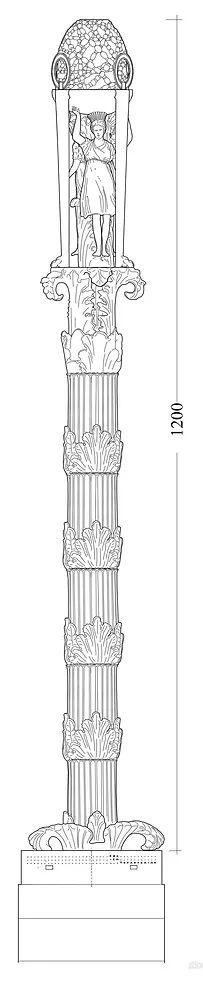
Here's how the column with the Omphalos looked like. Neither of the originals were found.
IV - A Strange Story
During my investigations, I got told about a legend regarding the Omphalos and its column. They were brought here by the first people of Greece. They established a cult dedicated to a snake-like deity and Mother Earth. The deity was probably Python.
The legend described the column as not looking anything like the one exposed on the museum, which was a late donation to the temple.
The story told that the Omphalos and the column were one and the same. Egg-shaped, green in color, like the scales of a snake. Within, swirling reddish-golden patters flow and crawls, like living snakes.
It is a pretty beautiful sight to behold.
But the description reminded me of something... The Emerald Tablet
A local told me that the Omphalos' powers goes way beyond the prophetic powers it was given. Its powers were much more important. He couldn't go into detailed but said that the alchemists most probably found ancient texts they didn't quite comprehend.
The same local told me about a text that contains all the secrets of the Omphalos. The text was taken by Jason and then mysteriously disappears of off the pages of History.
He told about the Golden Fleece... Interesting... That opens up for a next chapter..."
Izmia closed the book.
By rereading it, something blossomed in her mind.
Commentaires
Enregistrer un commentaire